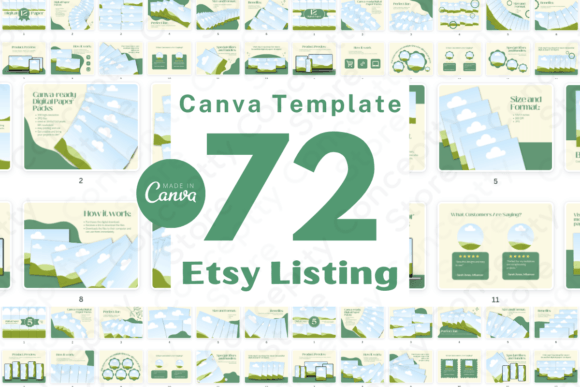
72-Page Etsy Listing Canva Template: A Comprehensive Evaluation
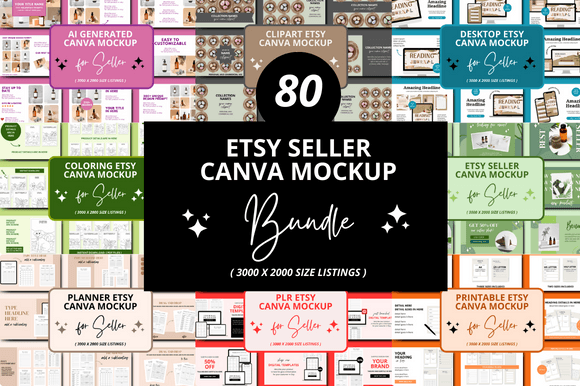
In the competitive landscape of online marketplaces, visual presentation is often the primary determinant of a customer's decision to click or scroll past. For digital creators and small business owners, maintaining a consistent and professional aesthetic across multiple product listings can be a significant logistical challenge. The 72-Page Etsy Listing Canva Template addresses this specific pain point by offering a scalable solution for creating cohesive product galleries. This tool is designed to streamline the listing creation process while adhering to modern design standards.
This evaluation explores the functionality, utility, and strategic value of the template. It examines who benefits most from this resource, the tradeoffs involved in using a pre-designed framework, and how it fits into a broader digital marketing strategy. By understanding the specific capabilities of this 72-page asset, sellers can make an informed decision about whether it aligns with their operational goals.
Understanding the Product Architecture
The core of this offering is a comprehensive set of 72 individual pages, divided into six distinct sets of templates. Each page within the collection serves a specific function within a single Etsy listing image sequence. Unlike standard single-image templates that require manual duplication and adjustment, this system provides a structured workflow. The dimensions are optimized for the platform, measuring 3000px wide by 2250px tall in a landscape orientation, ensuring high-resolution output without pixelation.
The template is built on a foundation of modern and minimalist aesthetics. This design philosophy prioritizes clean lines, ample white space, and clear typography. Such a style is particularly effective for digital products like paper packs, seamless patterns, and mockups, where the focus must remain on the product itself rather than decorative elements. The layout variations allow for different types of content distribution:
- Cover Pages: Designed to capture immediate attention in search results.
- Showcase Sections: Areas dedicated to displaying creative projects or finished examples.
- Product Previews: Dedicated slots for close-up details and texture shots.
- Informational Pages: Layouts for size specifications, format details, and usage instructions.
- Social Proof: Designated spaces for testimonials and user feedback.
- Call-to-Action (CTA): Strategic endings to encourage purchases or bundle additions.
Strategic Benefits for Digital Sellers
The primary advantage of utilizing the 72-Page Etsy Listing Canva Template lies in efficiency and brand consistency. Creating a multi-image listing from scratch requires not only design skills but also a significant time investment. By providing a pre-established grid and element hierarchy, this template reduces the cognitive load on the seller. Users can focus on selecting high-quality imagery and writing compelling copy rather than wrestling with alignment tools or font pairings.
Consistency is a critical factor in building trust with potential buyers. When a shop features a uniform visual language across all listings, it signals professionalism and reliability. This template facilitates that consistency by allowing users to maintain a specific color palette, font family, and layout structure across dozens of products. For sellers expanding their inventory rapidly, this uniformity helps establish a recognizable brand identity without requiring a full-time graphic designer.
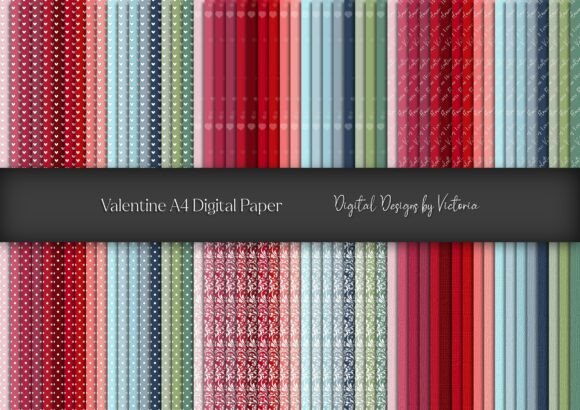
Furthermore, the versatility of the 72-page structure supports diverse product categories. While originally highlighted for digital papers, the modular nature of the design allows it to adapt to various digital goods. Whether selling pattern packs, social media kits, or printable planners, the ability to switch between a "lifestyle" view and a "technical specs" view ensures that every aspect of the product is communicated effectively.
Considerations and Potential Tradeoffs
While the template offers significant advantages, it is important to evaluate its limitations relative to other solutions. The primary constraint is the fixed design framework. Although the layouts are versatile, they are not infinitely customizable. Sellers who require highly unique, avant-garde, or non-standard designs may find the minimalist approach too restrictive. The template dictates a certain flow; deviating significantly from this flow might undermine the intended aesthetic balance.
Another consideration is the reliance on the Canva ecosystem. While Canva is a robust platform, users must have access to the necessary Pro features if they intend to use premium elements included in the template. Additionally, the learning curve, while generally low, exists for those unfamiliar with layer management or drag-and-drop interfaces. However, for most users, the interface remains intuitive enough to produce professional results quickly.
There is also the question of originality. Because these templates are available to multiple users, there is a risk that some listings may appear similar to others in the marketplace. To mitigate this, sellers must invest heavily in their photography and copywriting. The template provides the stage, but the quality of the performance depends entirely on the assets uploaded by the user. High-resolution, well-lit photos are essential to distinguish a listing from competitors using the same background.
Identifying the Ideal Use Case
This resource is best suited for established Etsy sellers looking to scale their operations or new sellers aiming to launch with a polished portfolio. It is particularly effective for:
- Digital Paper Creators: Who need to display large quantities of patterns efficiently.
- Mockup Artists: Who require consistent backgrounds to showcase their designs.
- Marketing Kit Providers: Who need to explain complex bundles through a step-by-step visual guide.
- Brand-Focused Shops: Where maintaining a strict visual identity is a priority over experimental design.
If your goal is to create a streamlined, professional-looking shop that maximizes conversion rates through clarity and speed, this template represents a strong fit. The inclusion of specific sections for testimonials, special offers, and bundles allows for a complete sales narrative within a single listing, reducing the friction for the buyer.
When Alternatives May Be Preferable
Conversely, there are scenarios where this template might not be the optimal choice. If a seller operates in a niche that relies heavily on bold, chaotic, or highly ornate aesthetics, the minimalist design of this template may clash with their brand voice. In such cases, hiring a custom graphic designer or purchasing a more stylized, niche-specific template might yield better results.
Additionally, sellers with very limited budgets who do not wish to subscribe to Canva Pro should consider free alternatives. While the 72-page structure is valuable, the cost of the subscription required to unlock all features could outweigh the benefits for a hobbyist with only one or two listings. Similarly, sellers who prefer Adobe Photoshop or Illustrator for advanced manipulation might find the Canva environment limiting compared to industry-standard software.
Decision-Making Insights
To determine if the 72-Page Etsy Listing Canva Template is right for you, consider your current bottlenecks. Are you spending hours adjusting margins and fonts? Do your listings look disjointed because you are changing styles for every product? If the answer is yes, this template offers a direct solution to those inefficiencies.
Evaluate the volume of your production. If you plan to release multiple collections or update your shop frequently, the time saved by using a pre-built 72-page system will likely pay for the investment many times over. The ability to reuse the same structure for different products creates a powerful economies-of-scale effect in your design workflow.
Finally, assess your commitment to visual quality. The template is only as good as the images you place within it. If you are willing to invest in high-quality photography and thoughtful copy, this tool will amplify your efforts. If you rely on generic stock images or low-resolution files, even the best template will struggle to elevate the perceived value of your products.
In conclusion, this template serves as a practical bridge between amateur presentation and professional branding. It balances flexibility with structure, making it a viable option for a wide range of digital product sellers who prioritize efficiency and visual coherence.